Stone bramble (Rubus saxatilis)
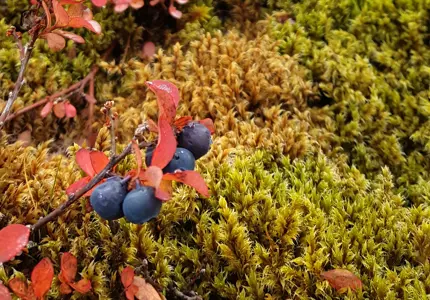
Rubus saxatilis or the stone bramble, a member of the rose family, is a species native to Europe, Greenland, Russia and parts of Asia. It is an indigenous species in all the Nordic countries. In the prioritised CWR species list it is in the secondary gene pool to Rubus idaeus. Saxatilis, meaning 'stone' or 'living among rocks', gestures to the plant's preferred habitat. The stone bramble can be found in rocky and ridged environments as well as mesic and deciduous broadleaf forests.
Danish: Fruebær | Finnish: lillukka | Icelandic: Hrútaberjalyng | Norwegian: Teiebær | Swedish: Stenbär
Rubus saxatilis is a low-growing creeping subshrub, the height of the stems ranging from 10 to 35 centimetres. The plant spreads very efficiently, as it grows long runners that spread across t forest floor. The runners then root at the tip to form new shoots. Each individual runner can gro up to 3.5 meters in length. In fact, there is a Finnish saying about getting tangled in the stone bramble's runners, that is to say 'getting too caught up in the details'.

The species flowers in the Nordics from June to July with greenish-white flowers, and produ berries until September. Its berries are shiny and red aggregate fruits. Compared to some other Rubus species the Rubus saxatilis berry is composed of fewer drupelets. The number of drupelets in each stone bramble’s berry ranges from 1 to 6.
As the number of the drupelets in each berry is quite low and the stone bramble doesn't produce a high number of berries, it is difficult to collect the berries in large quantities. Therefore, the aren't many well-established uses for the species. Nonetheless, the berries are edible, with an slightly tart taste. They can be eaten raw or turned into jam or juice for example. It also could have medicinal uses, mostly because of the tannins present in the plant.
Rubus saxatilis isn't being cultivated for its fruit. However, it is a close relative to more economically important Rubus species. Furthermore, it can be grown in gardens as an ornamental plant.
Rubus saxatilis can hybridise with Rubus arcticus. The hybrid Rubus x castoreus is native to northern Sweden, Norway, Finland and Russia. The hybrid produces flowers, but no fruit.
References
Botanical Society of Britain & Ireland. (n.d.) Rubus saxatilis L., Stone Bramble. https://bsbi.org/in-your-area/local-botany/co-fermanagh/fermanagh-species-accounts/rubus-saxatilis-l
Charlton T. Lewis & Charles Short. (n.d.) A Latin dictionary: saxatilis. https://www.perseus.tufts.edu/hopper/text?doc=Perseus:text:1999.04.0059:entry=saxatilis
Fitzgerald H, Palmé A, Aronsson M, Asdal Å, Bjureke K, Endresen D, Hyvärinen M, Kiviharju E, Lund B, Nilsen L B, Göransson M, Thorbjornsson H, Weibull J, Wind P, Rasmussen M, Borgen Nilsen L, Helpdesk G, Palmé A, Bakken V (2023). Nordic crop wild relative priority list. Version 1.15. Nordic Genetic Resource Center (NORDGEN). Checklist dataset https://doi.org/10.15468/4t4bm5 accessed via GBIF.org on 2026-10-26.
NatureGate. (n.d.) Stone Bramble. https://luontoportti.com/en/t/313/arctic-bramble
Plants For A Future. (n.d.) Rubus saxatilis - L. https://pfaf.org/user/Plant.aspx?LatinName=Rubus+saxatilis
Plants of the World Online. (n.d.) Rubus saxatilis L. https://powo.science.kew.org/taxon/urn:lsid:ipni.org:names:735725-1